
NAMs Network

NAMs Network

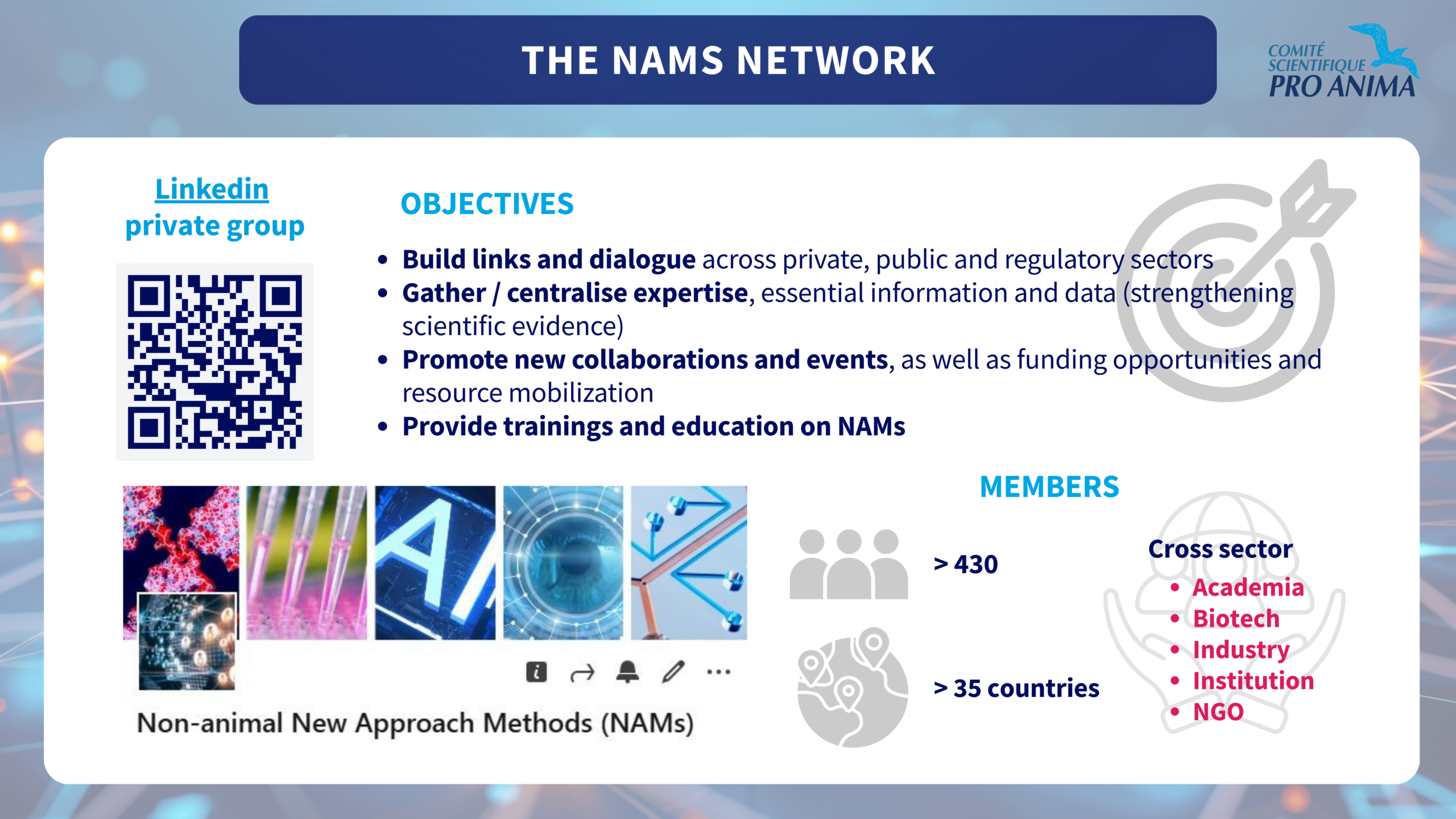
This network aims to bring together all individuals interested in the field of alternative methods to animals for scientific purposes (in vitro, in silico, etc.): researchers, engineers, industrialists, regulators and institutions. The idea is to create a broad network to foster dialogue between key players, share important information, generate new collaborations and gather solid scientific data to validate and promote alternative methods to animal experimentation.


Main objectives of the network 

  • Building links and dialogue across private, public and regulatory sectors
  • Gather expertise, essential information and data (strengthening scientific evidence)
  • Promoting new collaborations and events, as well as funding opportunities and resource mobilization
  • Training and educating the scientific community on NAMs

Tools

A Linkedin group

With more than 430 members (from industry, biotech, academia, etc, and different regions of the world), it was launched for daily / regular interactions and information sharing ; moderated by Pro Anima.


Monthly Live Talks

This year, we are setting up a series of Live talks on NAMs. The idea is to take 1h every month to freely discuss on a burning topic related to NAMs with the members of the network and external guests.

If you want to contribute to the framing of the next sessions, kindly contact us.

Next session

Session 4: Europe in Transition — Scaling Human-Relevant Research Through NAMs, May 27th 10am-11am (CET)

As Europe accelerates its transition toward non-animal methods (NAMs), how can scientific breakthroughs translate into real-world adoption? This session explores how cutting-edge innovation, regulatory frameworks, and institutional dynamics must align to scale human-relevant research.

Featuring Prof Hans Clevers (Utrecht University), a pioneer of organoid technology, the discussion will highlight how advanced in vitro models are reshaping our understanding of human biology and enabling more predictive science.

The session is facilitated by Daniela Salvatori (Utrecht University), interim director at the Ombion Center for Animal-free Biomedical Translation, whose work bridges biomedical research, education, and the implementation of animal-free approaches.

Together, they will explore not only the scientific potential of NAMs, but also the systemic challenges — regulatory acceptance, cultural inertia, and coordination across stakeholders — that determine whether these innovations reach scale.

What to expect:

  • Breakthrough insights into organoids and advanced NAMs
  • A systems-level perspective on barriers to adoption
  • Practical reflections on how Europe can lead the shift to human-relevant research


Guest: Prof Hans Clevers, Utrecht University

Hans Clevers, MD, PhD is Professor of Molecular Genetics at Utrecht University and a leading figure in stem cell biology. He identified key effectors of the Wnt signaling pathway (TCF transcription factors) and discovered LGR5 as a marker of adult stem cells, advancing understanding of intestinal biology and cancer. He later pioneered organoid technology — 3D in vitro models that closely mimic human organs — transforming biomedical research.

He trained at Utrecht University and has held major leadership roles, including directing the Hubrecht Institute and serving as president of the Royal Netherlands Academy of Arts and Sciences. He also led Pharma Research & Early Development at Roche, where he helped establish the Institute of Human Biology in Basel. He continues to oversee research groups at the Hubrecht Institute and the Princess Máxima Center.

Clevers has received numerous international honors, including the Breakthrough Prize in Life Sciences, and is a member of several prestigious academies worldwide.

Facilitator: Prof Daniel Salvatori, Ombion Center for Animal-free Biomedical Translation

Daniela is Professor of Comparative Anatomy and Physiology at Utrecht University and head of its Anatomy and Physiology division. She chairs the Transition to Animal-Free Innovation (TPI) Utrecht initiative and is interim director of the OMBION Center for Animal-free Biomedical Translation.

Her work spans stem cell safety and disease modeling, alongside the development of advanced training tools such as 3D, virtual reality, and holographic models through the Center of Excellence in Plastination and Virtual Reality. She is actively advancing the transition toward human-relevant, animal-free approaches in biomedical research and education.

Previous sessions

Session 1: Introducing the NAMs Network and the Live Talks Series — February 4th, 12 – 1pm (CET)

Session 2: Where are we with NAMs, and why? – A US perspective, March 5th 4pm-5pm (CET)

In this session, we discussed the current momentum in the US with a focus on the role of NAMs to address the problem of translatability — starting by defining the magnitude of the issue, identifying key challenges, and then discussing perceived solutions and remaining risks across science, regulation, and policy.


Guest: Dr Daniel Levner, Co-Founder & CTO at Emulate Inc.

Daniel is the Chief Technology Officer at Emulate. A serial deep-tech entrepreneur, Levner co-founded Emulate and brings to it extensive experience in biological and engineering technology development and commercialization. Levner joined the Emulate founding team during his role as a Senior Staff Scientist with the Wyss Institute for Biologically Inspired Engineering at Harvard University. There, he led the advanced engineering team responsible for developing the Emulate Organ-Chip platform and played a key leadership role formulating innovative approaches for bridging biologists, engineers and business stakeholders. Daniel received his PhD in electrical engineering from Stanford University as well as an MS in aeronautics and astronautics, also from Stanford. He has authored numerous publications and more than 70 issued and pending US patents. Q&A: you can submit questions ahead on the registration form below.

Facilitator: Dr. Zaher Nahle, CHE & Ivyctory Solutions

Zaher Nahle is an interdisciplinary executive scientist with senior leadership experience across biomedical research, academia, and public policy, including roles as Chief Scientific Officer, Vice President for Research, and CEO at major U.S. medical foundations. He earned his PhD in Physiology and Biophysics from the Stony Brook University/Cold Spring Harbor Laboratory joint program, his Master’s in Public Administration from Harvard University, and his certificate in Public Policy and Management from Harvard Kennedy School, where he was a Mason Fellow. A former faculty member at Vanderbilt and Cornell, he has published extensively in leading journals and pioneered high-throughput technologies such as gene microarrays. He currently serves as Senior Scientific Advisor to the Center for a Humane Economy and Animal Wellness Action and is the founder of the IVYCTORY Group.


Session 3: How to mitigate the socio-technical barriers to the uptake of NAMs?, April 20th 1pm-2pm (CET)

In this session, we explored the key barriers to the adoption of NAMs and identify practical ways to overcome them. Laura Holden will present insights from the PrecisionTox study, highlighting technical, institutional, and cultural challenges, while Love Hansell will guide the discussion and help uncover overlooked barriers.

Through live polls, structured dialogue, and audience Q&A, we tempted to examine where these barriers arise, why stakeholders disagree, and what realistic steps can accelerate adoption. The session concluded with this takeaway: the complexity is real and needs to be embraced and discussed broadly if we want a chance to move foward and mitigate some barriers.


Guest: Laura Holden, University of Birmingham

Research Fellow at the University of Birmingham, specialising in environmental law and regulatory change. A former UK regulator and advisor to Defra, she works on biodegradation of polymers, environmental mixtures, and regulatory acceptance of AI within PARC, NAMWISE, and PrecisionTox.

Co-host & Facilitator: Love Hansell, Radboud University 

PhD student in social sciences specialising in political science at the Radboud University at Nijmegen School of Management, analyses the institutional and social dynamics that influence the adoption of NAMs. As a contributor to the communication and dissemination strategy for NAMs, his interdisciplinary perspective is essential to understanding the non-technical barriers and drivers of the transition.

An event interface

To not miss any upcoming event on NAMs.


Contact


Dr Lilas Courtot

File:LinkedIn logo initials.png - Wikimedia Commons