


NAMs Live Talks
Session 4: Europe in Transition — Scaling Human-Relevant Research Through NAMs
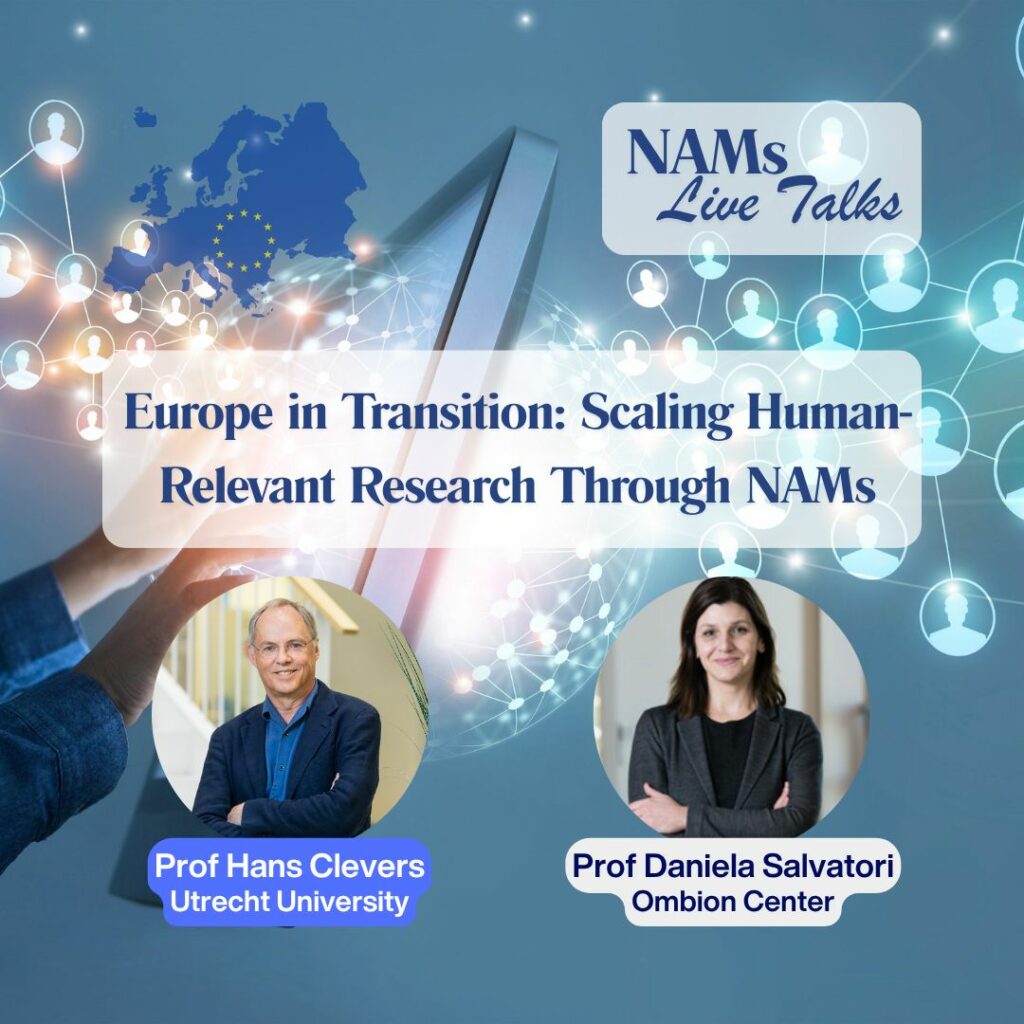
The fourth NAMs Live Talks session explored how breakthroughs in non-animal methodologies (NAMs) can move from research to real-world adoption, with a focus on organoid technology and implementation frameworks. Hans Clevers highlighted the origins and applications of organoids in drug development, disease modeling, and personalized medicine. Daniela Salvatori presented Ambion, a €125 million Dutch initiative supporting animal-free biomedical translation.
Key challenges discussed included the lack of standardized organoid protocols, regulatory readiness, industry trust, and education. A centralized, living repository of validated organoid protocols accessible to academia and industry was proposed as a practical step toward regulatory acceptance. Participants also emphasized that validation frameworks must be co-developed with regulators and industry to ensure relevance and adoption. Europe has strong scientific leadership in organoid technology but risks losing momentum due to fragmented funding, regulatory burden, and limited coordinated infrastructure investment, while China and the US accelerate large-scale implementation efforts. Models such as Ambion — public-private partnerships designed to bridge innovation and application — were highlighted as important frameworks to replicate across Europe.
Guest: Prof Hans Clevers, Utrecht University
Hans Clevers, MD, PhD is Professor of Molecular Genetics at Utrecht University and a leading figure in stem cell biology. He identified key effectors of the Wnt signaling pathway (TCF transcription factors) and discovered LGR5 as a marker of adult stem cells, advancing understanding of intestinal biology and cancer. He later pioneered organoid technology — 3D in vitro models that closely mimic human organs — transforming biomedical research.
He trained at Utrecht University and has held major leadership roles, including directing the Hubrecht Institute and serving as president of the Royal Netherlands Academy of Arts and Sciences. He also led Pharma Research & Early Development at Roche, where he helped establish the Institute of Human Biology in Basel. He continues to oversee research groups at the Hubrecht Institute and the Princess Máxima Center.
Clevers has received numerous international honors, including the Breakthrough Prize in Life Sciences, and is a member of several prestigious academies worldwide.
Facilitator: Prof Daniel Salvatori, Ombion Center for Animal-free Biomedical Translation
Daniela is Professor of Comparative Anatomy and Physiology at Utrecht University and head of its Anatomy and Physiology division. She chairs the Transition to Animal-Free Innovation (TPI) Utrecht initiative and is interim director of the OMBION Center for Animal-free Biomedical Translation.
Her work spans stem cell safety and disease modeling, alongside the development of advanced training tools such as 3D, virtual reality, and holographic models through the Center of Excellence in Plastination and Virtual Reality. She is actively advancing the transition toward human-relevant, animal-free approaches in biomedical research and education.